
Renewal Optimization
Exploring renewal clarity through a CX-led lens
Context
This project explored improvements to a B2B renewal experience where customers frequently relied on support to understand renewal status and next steps. The work took place within a CX-led team, with design focused on early experience exploration rather than implementation.
Problem Space
Customers frequently received multiple automated emails related to renewal status and timing. While each message was accurate on its own, the volume and overlap made it difficult to determine which emails actually required follow-up.
Over time, customers began ignoring renewal emails altogether, increasing uncertainty and driving unnecessary support contacts.
The core problem was not a lack of communication but a loss of signal caused by over-notification.
.jpg)
CX Signal
This pattern was consistently observed among CX specialists who supported customers directly. Many customer inquiries were not about changing renewals but about confirming which emails were relevant and whether any action was required.
These conversations reinforced that clarity and prioritization — not more reminders — were the missing pieces.
My Role & Scope
This was my first UX project as a contractor, working within a CX-led team. I reported to a CX manager and collaborated closely with CX specialists who interacted with customers daily.
I did not have direct access to customers, business stakeholders, or engineering teams. My work was guided by my manager's project direction and qualitative insights from CX specialists.
Within this scope, my responsibility was to translate CX-informed problems into UX explorations that helped the team reason about clarity, status, and customer confidence.
Design Focus

Restoring signal from noisy renewal communications

Making it clear when action was required

Providing a reliable source of truth inside the product
Key Experience Explorations
Exploration 1
Is this email actionable or just informational?
This notification was designed to restore signal in a noisy communication environment. Instead of relying on urgency alone, the experience surfaces a clear renewal summary, prioritizes key opportunities, and highlights whether action is actually required.
By consolidating renewal insights into a single, scannable view, the notification helps partners quickly decide whether to engage now or safely defer.
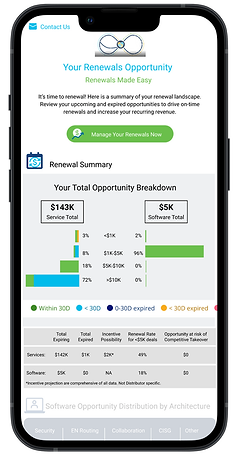
Why this restores clarity
The notification prioritizes only the information partners need to make an immediate decision:
-
a summarized renewal opportunity
-
clear prioritization of contracts that matter
-
early signals that warrant follow-up
Supported next steps
Once partners understand their renewal status, the experience offers clear next steps without forcing immediate action. This allows users to either proceed confidently or defer without uncertainty.
Exploration 2: Partner View
Installed Base Overview

Question:
How would a partner quickly confirm which customers’ renewals are expiring or already expired?
Exploration:
To think this through, I explored a simple overview of the installed base from a partner’s perspective. The focus was on scanning across multiple customers to spot renewal status, rather than on detailed device information.
Learning:
This helped me understand that partners need summarized, time-based signals to prioritize customers, even when working with the same underlying data as customers.
Exploration 3: Renewal Date
CCWR

Question:
Where do partners check whether a customer’s renewal is active, expiring, or expired?
Exploration:
I looked into CCW-R to understand how partners confirm renewal status today, with a focus on how quickly they can find and interpret that information.
Learning:While the data is available, it’s easier to review one customer at a time than to scan across multiple customers.
Synthesis Across Explorations
Across these explorations, a consistent pattern emerged:
Information can exist without being actioable
The same data needs to be summarized differently depending on role
Timing and urgency matter more than completness
Reflection
How I think about this today
Looking back, these explorations shaped how I approach enterprise UX problems. Value doesn’t come from exposing more data, but from helping the right person recognize what matters and act with confidence—especially when managing complexity across roles and accounts.
What I would push forward next
If this were taken further, I would focus on defining role-based summaries and renewal-risk thresholds before designing additional UI, ensuring the experience supports decision-making rather than navigation.


